Small living room ideas work best when the room is measured before it is furnished. A loveseat that fits the longest wall, one rug that draws the seating group, and light that comes from three low sources instead of one bright ceiling fixture will do more for a small room than any single piece of furniture. The 15 ideas below follow that rule, one problem at a time, from the floor plan to the curtains.
The colour story for this look is warm white, oatmeal, pale clay and soft sage, with light oak, linen and bouclé to soften the edges. Nothing here needs a renovation — every idea works with the walls, windows and floor the room already has — and the same small-bedroom logic that makes a tiny bedroom work applies here too: fewer, better-chosen pieces, each one earning its floor space. Pick the idea that fits the room’s worst problem first, live with it for a day, and add the next only when the room asks for it.
Small Living Room Ideas: 15 Ways to Make a Tiny Room Feel Bigger
1. Start with a Tape Measure, Not a Sofa

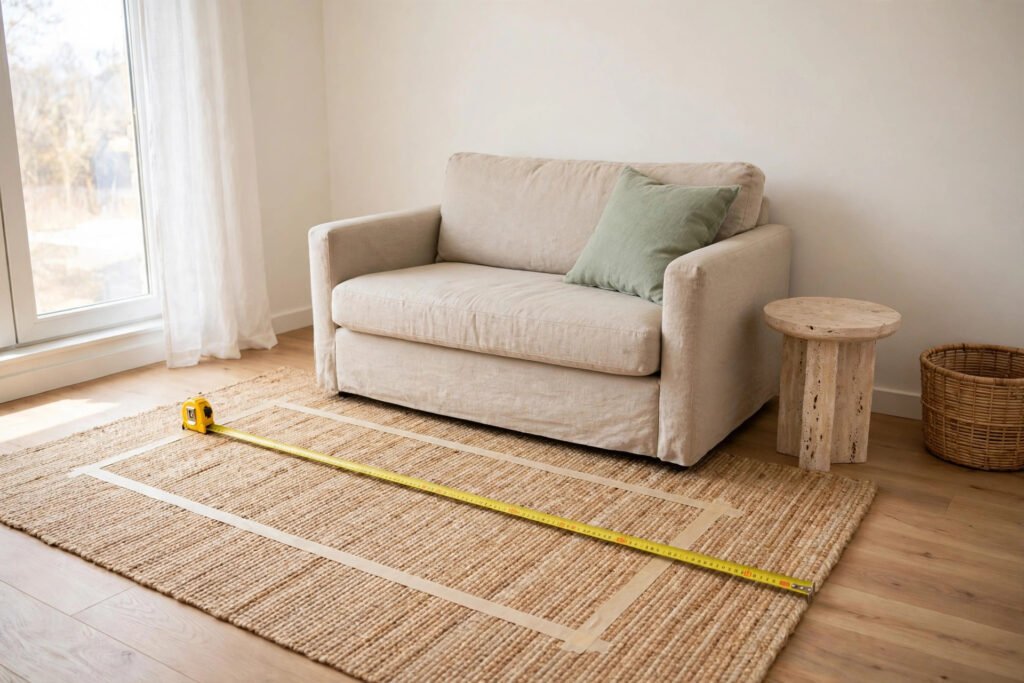
Small living room ideas start with a tape measure: the main wall’s length, the room’s depth, and the paths people take through it. Keep about 36 inches clear for each walkway, then choose a sofa or loveseat sized to the wall that is left — colour, light and mirrors come after, and they help most once the floor plan already works. Mark the sofa’s footprint on the floor with painter’s tape and live with the outline for a day, so the walkways prove themselves before any furniture arrives. A room under about 150 square feet suits this approach best, since every inch is already spoken for, and a taped outline costs nothing to move.
2. Angle the Loveseat into the Corner
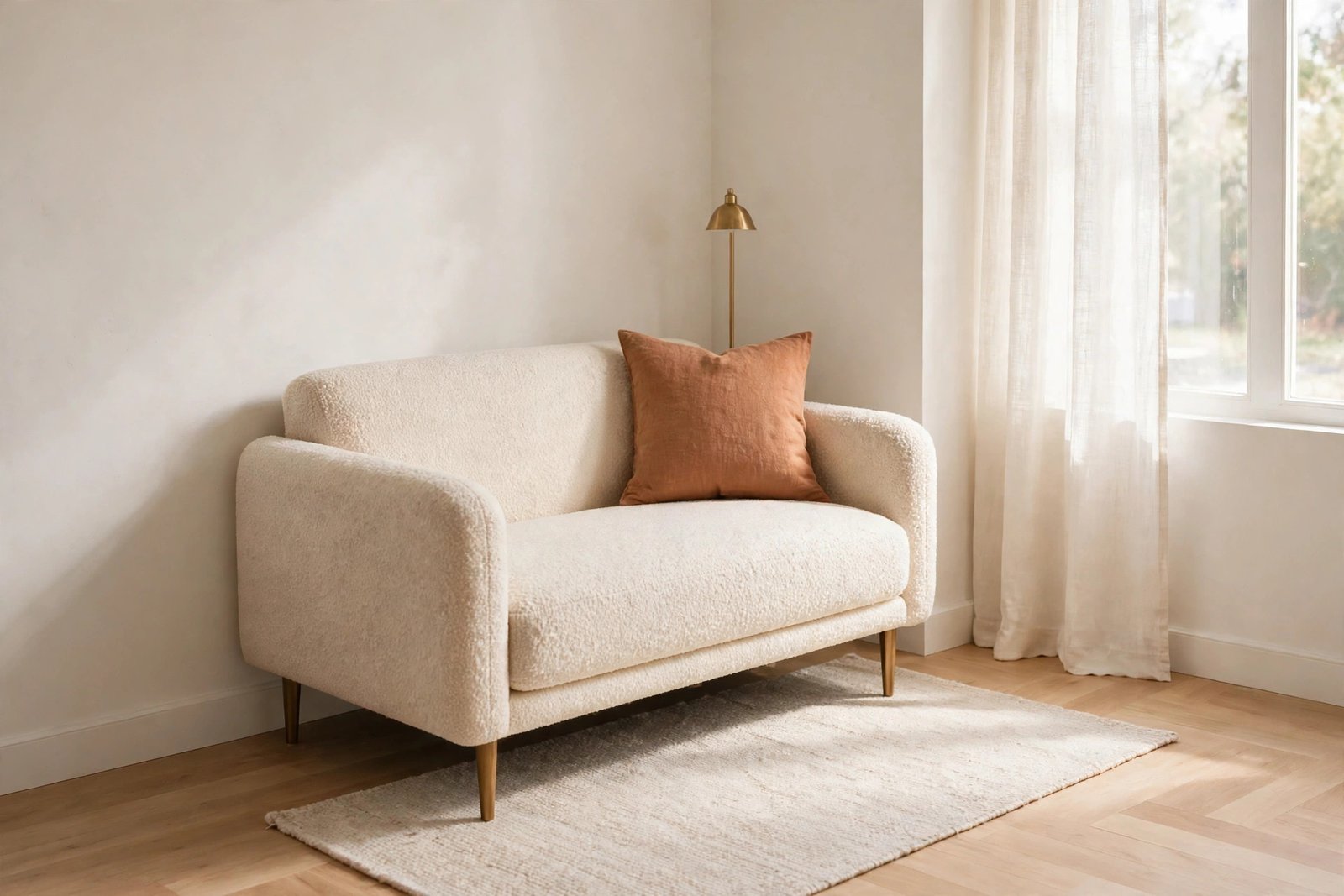
Angle a compact loveseat into the corner at roughly 45 degrees and the room gains a diagonal sightline from the door, which reads as depth. The dead corner behind the loveseat takes a floor lamp, so no floor space is lost to the angle at all. A square room around 10 by 12 feet suits this layout best, and a low-profile loveseat in linen or bouclé keeps the angled piece from looking bulky. Leave a few inches behind the loveseat for the lamp cord, and pull the front legs onto the rug so the angle looks deliberate rather than accidental.
3. Keep One Seating Group and Let the Rug Draw It

Keep one seating group — a sofa and two chairs, or a loveseat and two chairs — and let a single rug draw its boundary, instead of splitting the room into two small zones that each feel cramped. A rug 5 by 8 or 6 by 9 feet suits most small living rooms, with the front legs of every seat resting on it, so the group reads as one intentional arrangement. A low-pile flatweave in a light neutral tone keeps the rug from adding visual weight, and a rug that floats with no legs on it shrinks the room, so size up rather than down. The walkways stay outside the rug, which keeps the paths clear and the seating calm.
4. Pick a Loveseat Under 78 Inches with Slim Arms

For a genuinely small living room, look for a compact sofa or loveseat under about 78 inches wide, with raised legs, slim arms or no arms at all, and a shallow seat depth. Track arms save six to eight inches over rolled arms, and legs that show the floor beneath keep the room airy where a skirted base would read as a solid block. Bouclé or washed linen in a warm neutral suits this scale best, since texture adds richness without visual weight. Measure the wall first and the loveseat second — a loveseat that is two inches too wide blocks the walkway for the life of the room.
5. Trade the Coffee Table for Nesting Tables

Trade the coffee table for a pair of nesting tables and the room gains a surface that appears only when it is needed. One table stays beside the sofa for a lamp or a drink, and the second tucks underneath until guests arrive, when it pulls out as an extra side table. Light oak or a glass top suits this swap best, since both keep the tables visually light, and a pair around 18 inches across fits beside most loveseats without crowding the walkway. Keep the tucked table empty, so it slides out cleanly, and let the tray on the top table hold the daily clutter instead.
6. Sit Two Armless Chairs Where a Second Sofa Would Go

Sit two armless slipper chairs where a second sofa would go and the room seats four without the bulk of a second full sofa. Armless chairs take a narrower footprint than armchairs, and two of them angled slightly toward the loveseat make conversation easy without blocking the path behind them. Linen or bouclé in the room’s accent colour suits this pairing best, and chairs with slim legs keep the floor showing beneath them. A chair around 24 inches wide fits most small rooms, and a small cushion in the room’s main colour ties the pair to the sofa.
7. Let a Storage Ottoman Do Three Jobs

Let a storage ottoman do three jobs — coffee table, footrest, and hidden storage — and one piece replaces three. A tray on top turns the ottoman into a table for drinks and books, the lid lifts for throws and magazines, and the whole piece slides aside when the floor needs clearing. A hinged lid in linen or velvet suits this role best, and an ottoman around 36 inches long sits comfortably in front of a loveseat without blocking the walkway. Keep the tray on top at all times, so the ottoman reads as a table, and store only soft things inside, so the lid always closes flat.
8. Tuck a Slim Console Behind the Sofa

Tuck a slim console table behind the sofa and the room gains a shelf, a lamp spot, and a basket of storage without giving up a single inch of floor it did not already use. A console 10 to 12 inches deep suits this spot best, with books and a small lamp on top and a basket beneath for throws or games. Light oak keeps the piece from reading as a wall, and a console at or below the height of the sofa back disappears from the front of the room entirely. Anchor it with a lamp at one end, so the back of the sofa looks finished from the doorway rather than bare.
9. Mount the TV and Free the Floor

Mount the television on the wall and free the floor where a TV unit would have eaten 18 inches of depth. A slim floating shelf below the screen holds the few boxes the room needs, and the clear floor beneath makes the whole wall feel lighter. Mount the centre of the screen at seated eye level, around 42 inches from the floor, so watching stays comfortable without a tilted neck. Hide the cables in a paintable channel that matches the wall, and keep the shelf to one or two objects, so the wall stays calm instead of crowded.
10. Layer Three Low Lights Instead of One Bright Ceiling Fixture

Layer three low lights — a floor lamp arcing over the reading corner, a small table lamp on a side table, and something low and warm near the floor like a lantern — instead of one bright ceiling fixture. One overhead light makes a small room feel flat and harsh, while three pools of warm light at different heights lift the dark corners and make the room feel larger than it is. Warm white bulbs around 2700K suit this layering best, and a dimmer on the floor lamp lets the room shift from bright daytime to soft evening. Place one light in each dark corner first, since a lit corner stops reading as a dead end.
11. Hang One Tall Mirror on the Window’s Side Wall

Hang one tall mirror on the wall beside the window and it brings the daylight and the view back into the room, doubling what the eye sees. A mirror 48 inches or taller in a slim frame suits this placement best, hung so its centre sits at eye level from the sofa. Check the angle from the seat before hanging — the mirror must reflect the window, not a blank wall or the television, or it doubles the wrong thing. One large mirror does more than a group of small ones here, since a single calm reflection reads as a window, while many small frames read as clutter.
12. Paint Walls, Trim and Ceiling One Pale Colour

Paint the walls, trim and ceiling one pale colour and the room’s edges blur, so it reads as one soft box instead of a small box with a lid. Warm white, oatmeal or pale clay suits this drenching best, in a matte finish on the walls and a satin finish in the same colour on the trim, so the surfaces stay related without going flat. A room with a low ceiling gains the most here, since the ceiling stops reading as a separate plane pressing down. Keep the floor light too — pale wood or a light rug — and let one darker piece, like a walnut side table, anchor the room so the pale scheme stays warm rather than washed out.
13. Keep the Big Pieces in One Colour Family

Keep the big pieces — sofa, chairs and rug — in one colour family and nothing chops the room into visual chunks. Two or three colours repeated around the room suit this discipline best: warm neutrals as the base, with one accent like sage or clay appearing in a cushion, a throw and a single piece of art. A moody neutral living room takes the opposite route, with deep tones doing the work, but in a small room the pale family keeps the pieces reading as one set. Repeat the accent at least three times, so it looks chosen rather than accidental, and keep the largest piece the palest, since a dark sofa dominates a small room.
14. Layer Two Rugs to Make the Seating Zone Feel Intentional

Small living room ideas often come down to one good rug decision: layer two rugs, a large natural-fibre base with a smaller patterned rug on top, and the seating zone feels intentional rather than just small. The base rug — jute or sisal, larger than the seating group — grounds the room, while the smaller top rug in a soft pattern adds warmth and marks where the seats belong. Keep the front legs of every seat on both rugs, so the layers read as one arrangement, and let the top rug sit at least six inches inside the base on every side. A flatweave top rug suits this layering best, since a thick pile on a thick base trips the eye and the feet.
15. Hang the Curtains High, Wide and to the Floor

Small living room ideas finish at the window: hang the curtains high, wide and to the floor, and a short window looks taller while a narrow one looks wider. Set the rod four to six inches above the window frame and six to twelve inches wider on each side, so the panels cover wall rather than glass when open, and let them fall to the floor — just kissing it, or puddling by an inch at most. Linen in a light-filtering weave suits this treatment best, since it softens the daylight without blocking it, and a single pair of panels in the room’s main colour keeps the window calm. Hang both panels at exactly the same height, since a crooked rod is the first thing the eye catches in a small room.
These ideas are a reminder that a small room is not a lesser room — it is a room that asks for better decisions. Measure first, keep one seating group, scale the furniture to the walls, and let light and colour do the work that floor space cannot. Start with the idea that fits the room’s worst problem, whether that is the layout, the light or the storage, and the room will feel bigger long before anything is bought.